
Go beyond the conference hall and witness landslide research in action. We are excited to offer delegates the unique opportunity to extend their WLF7 experience with specialized post-forum field visits. These excursions are designed to provide practical insights into landslide mitigation and monitoring in some of India’s most critical geological regions.
Participants can view the field visit options and provide their field visit preference through the myWLF7portal.
Please note that these field visit activities are scheduled to take place from November 28th to December 2nd post the event.
| Early (Oct 15, 2026) | Late (Oct 30, 2026) | |
|---|---|---|
| Western Ghats | USD 600 | USD 650 |
| Northern Himalayas | USD 300 | USD 350 |
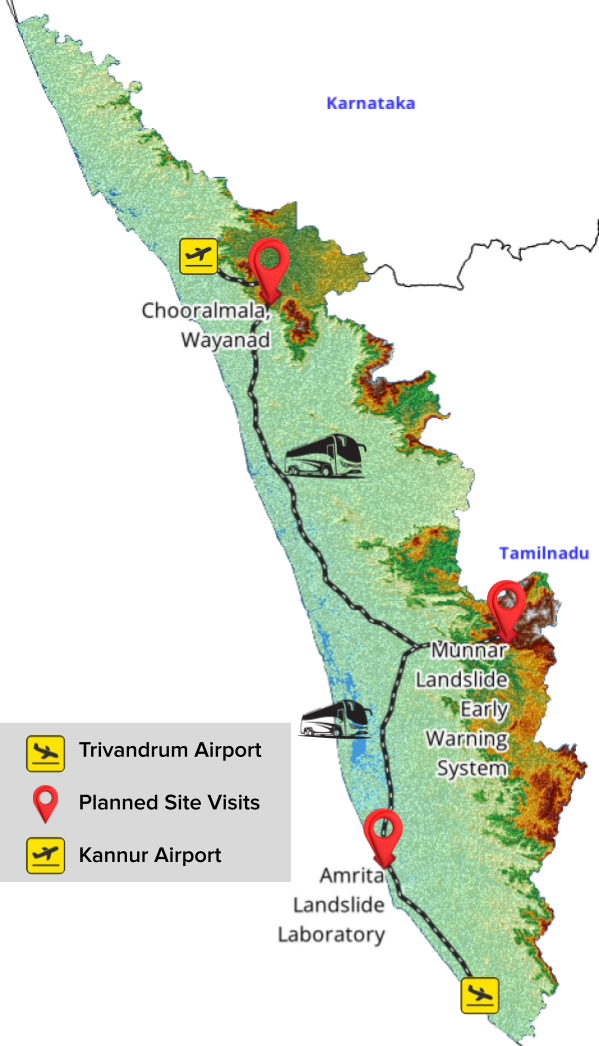
This field excursion takes participants through the Kerala and Western Ghats region, visiting key landslide disaster sites, active early warning systems, and a world-class landslide research laboratory. The route combines scientific inquiry with firsthand exposure to one of India’s most landslide-vulnerable landscapes.
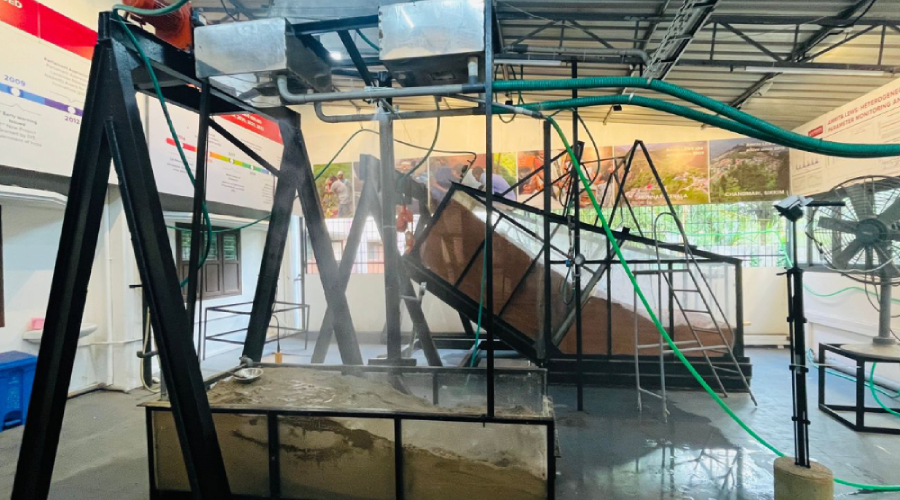
The Amrita Landslide Laboratory, established by Amrita Vishwa Vidyapeetham, is a dedicated research and testing facility for studying landslide behaviour, slope stability, and early warning technologies. The facility enables the creation of artificial landslides under fully controlled conditions — with adjustable parameters including slope angle, particle size distribution, rainfall intensity, rainfall duration, and soil moisture content.
The laboratory also serves as a platform for testing wireless sensor networks, signal processing systems, geotechnical instruments, and monitoring devices used in landslide-prone areas. Researchers and students use the facility to simulate real-world landslide conditions, evaluate sensor performance, and develop innovative disaster mitigation solutions. The laboratory has made significant contributions to landslide science, disaster management, and sustainable development across the Western Ghats.
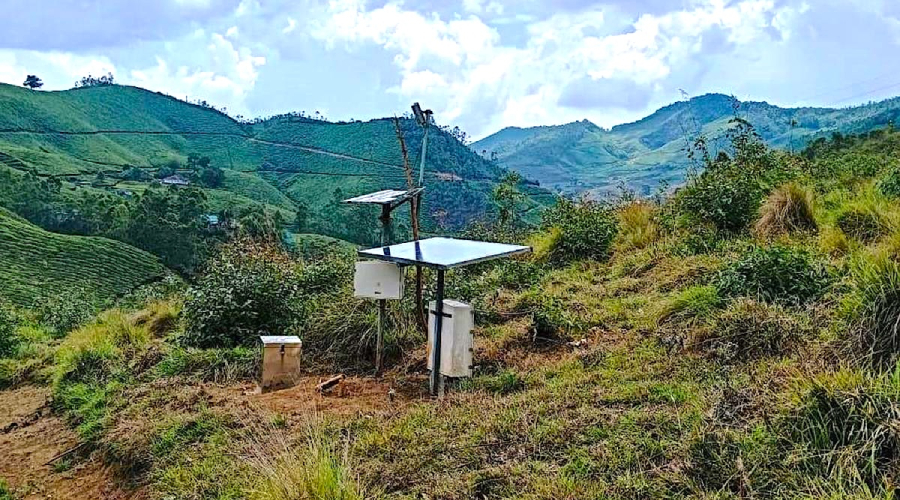
The Munnar Landslide Early Warning System is an advanced real-time monitoring network developed by Amrita Vishwa Vidyapeetham to detect slope instability in vulnerable hillside terrain. The system integrates wireless sensor networks, rainfall sensors, soil moisture sensors, tilt meters, and machine-learning-based analytics to identify potential landslide activity before failure occurs.
Deployed in the landslide-prone areas of Munnar in Idukki district, the system continuously collects environmental data and issues alerts to local authorities and communities. It represents one of India’s pioneering efforts in IoT-based disaster risk reduction, aiming to reduce casualties and minimise infrastructure damage during extreme rainfall events.
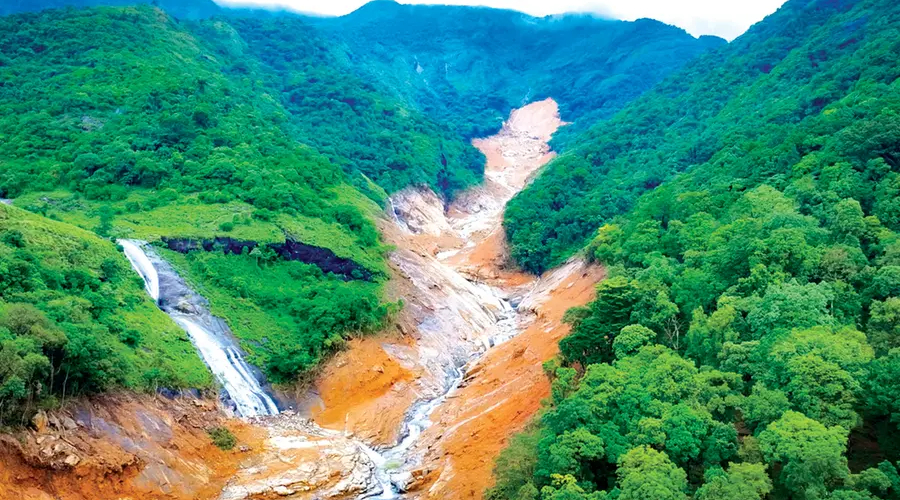
The Chooralmala–Mundakkai landslide in Wayanad was one of the most catastrophic landslide disasters in Kerala’s recorded history. On 30 July 2024, following sustained and intense monsoon rainfall in the Western Ghats, massive debris flows and flash floods devastated Chooralmala and several surrounding villages — destroying homes, roads, bridges, and community infrastructure, and resulting in heavy loss of life and large-scale displacement.
The disaster highlighted the extreme vulnerability of ecologically sensitive hill regions to the combined effects of extreme rainfall, deforestation, slope instability, and unplanned development. It also reinforced the critical need for scientific hazard mapping, community-level disaster preparedness, and effective early warning systems in landslide-prone areas.
| Date | Time | Place | Activity / Details |
|---|---|---|---|
| 28 Nov | 5:00 | Delhi Airport | Participants assemble at the airport for check-in and boarding |
| 07:20–10:35 | Delhi | Air India Express IX1811 | |
| 07:20–10:36 | Flight | Breakfast in flight | |
| 10:35–11:30 | Kochi Airport | Arrival, baggage collection and assembly | |
| 11:30–13:00 | Kochi | Depart Kochi by bus | |
| 13:00–14:00 | En route | Lunch stop – buffet | |
| 14:00–17:30 | En route | Continue journey to Munnar | |
| 17:30–18:30 | Munnar | Check-in to rooms | |
| 18:30–19:30 | Hotel | Field-visit orientation & briefing | |
| 19:30 onwards | Hotel / Munnar Town | Dinner | |
| 29 Nov | 07:00–08:00 | Hotel | Breakfast at hotel |
| 08:00–08:45 | Hotel | Travel to field site | |
| 08:45–12:30 | Munnar LEWS Site | Visit to Munnar Landslide Early Warning System | |
| 12:30–13:30 | Munnar | Lunch – packed tiffin | |
| 13:30–14:15 | Munnar | Travel to Munnar College landslide site | |
| 14:15–16:30 | Munnar College Landslide | Visiting Munnar College Landslide & Bio-mitigation | |
| 16:30–17:15 | Munnar | Return to hotel | |
| 19:30 onwards | Hotel | Dinner | |
| 30 Nov | 06:30–07:30 | Hotel | Breakfast at hotel |
| 07:30–08:00 | Hotel | Check-out and loading of luggage | |
| 08:00–10:00 | Munnar | Travel to Pettimudi | |
| 10:00–13:00 | Pettimudi Landslide Area | Visiting Pettimudi Landslide Field | |
| 13:00–14:00 | Pettimudi | Lunch – packed tiffin | |
| 14:00–18:00 | Pettimudi | Road journey to Kollam | |
| 18:00 onwards | Kollam | Check-in to room | |
| 19:30 onwards | Kollam | Dinner | |
| 1 Dec | 07:00–08:00 | Kollam | Breakfast at hotel/accommodation |
| 08:00–08:30 | Kollam | Travel to laboratory | |
| 08:30–12:00 | Landslide Laboratory | Visit to Landslide Laboratory | |
| 12:00–13:00 | Kollam | Lunch – buffet | |
| 13:00–15:00 | Kollam | Travel to Varkala | |
| 15:00–16:30 | Varkala Cliff | Visiting Varkala Cliff Geological Site | |
| 16:30–18:15 | Varkala | Transfer to airport | |
| 18:15–19:15 | Trivandrum Airport | Check-in, security and boarding | |
| 19:35–23:05 | Trivandrum | Air India AI1830 | |
| 19:35–23:05 | Flight | Dinner in Flight | |
| 23:05 | Delhi | Arrival; field visit concludes |
This excursion through Uttarakhand — one of India’s most disaster-prone hill states — visits landmark landslide-mitigation projects, critical hydropower infrastructure, and recent catastrophic-disaster sites in the Garhwal Himalaya.
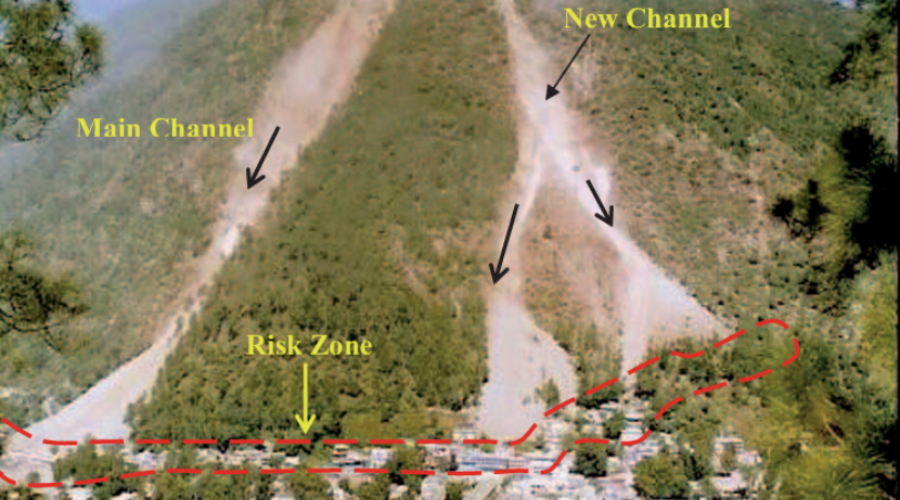
The Varunavat landslide mitigation project is located at Varunavat hill in Uttarkashi, Uttarakhand. In September 2003, following heavy monsoon rains, a large landslide struck the area, causing extensive damage to residential properties, road infrastructure, and public facilities, and posing a serious risk to local communities.
In response, the Government of Uttarakhand and relevant geological authorities undertook a comprehensive set of mitigation measures, including slope stabilisation, retaining wall construction, rock bolting, wire mesh installation, surface drainage improvement, and afforestation to control soil erosion. Scientific slope movement monitoring and early warning systems were also established as part of the disaster risk reduction strategy. The Varunavat Landslide Mitigation Project is widely cited as an important example of disaster risk reduction in the Indian Himalayas, having helped restore slope stability and protect the town of Uttarkashi.
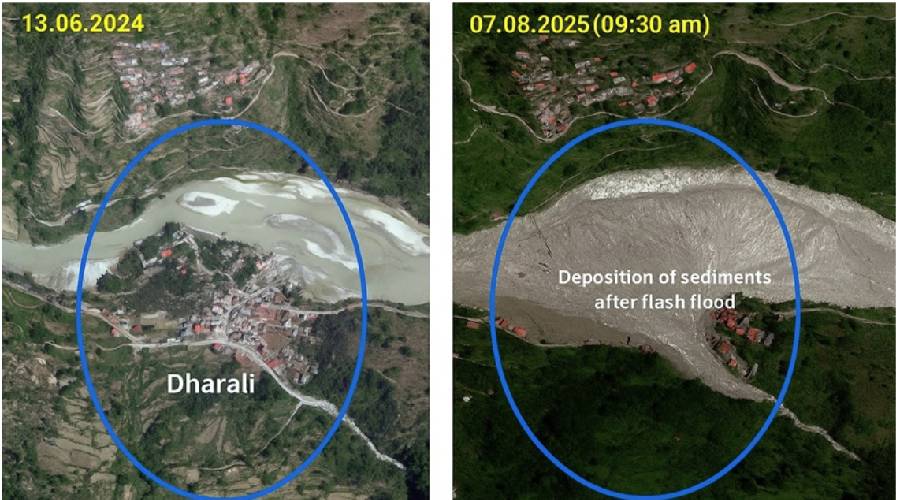
The Dharali Disaster refers to a major natural calamity that struck the village of Dharali in Uttarkashi district, Uttarakhand, on 5 August 2025. The event was triggered by extreme rainfall leading to flash floods and multiple landslides that devastated the fragile Himalayan terrain. Rivers burst their banks and slope failures destroyed roads, buildings, bridges, and agricultural land, causing severe hardship to local residents.
The incident underscored the heightened vulnerability of Himalayan communities to the compounding effects of climate change, deforestation, and unregulated development — particularly under conditions of extreme weather. Government agencies, emergency response teams, and local volunteers undertook rescue and relief operations. Post-disaster efforts have focused on slope stabilisation, drainage improvement, early warning system installation, and improved land-use planning. The Dharali disaster is now recognised as an important case study in mountain disaster preparedness and climate-resilient development.
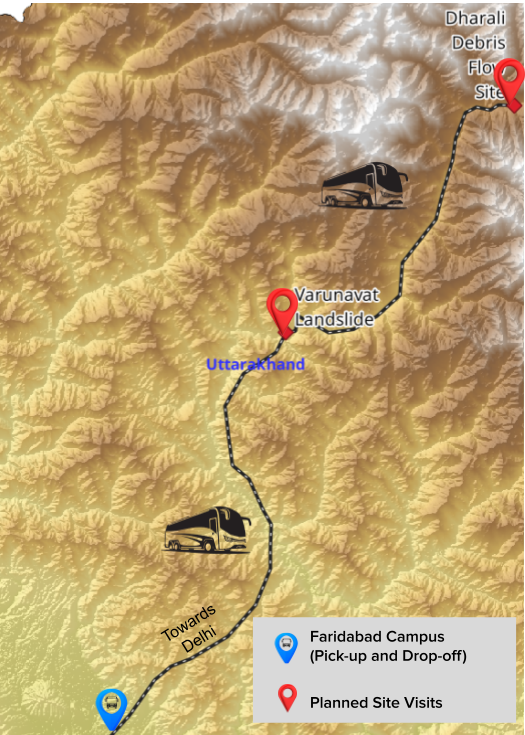
| Date | Time | Place | Activity / Details |
|---|---|---|---|
| 28 Nov | 06:30–07:30 | Faridabad Campus | Breakfast |
| 07:30–07:45 | Faridabad Campus | Check-in and luggage loading | |
| 07:45–13:00 | Faridabad | Departure of study tour bus | |
| 13:00–14:00 | En route | Lunch stop | |
| 14:00–19:00 | En route | Continue journey to Uttarkashi | |
| 19:00–19:30 | Uttarkashi | Arrival and Room Check-in | |
| 19:30–20:00 | Hotel | Refreshments | |
| 20:00 onwards | Hotel / Uttarkashi Town | Dinner | |
| 29 Nov | 07:00–08:00 | Hotel | Breakfast at hotel |
| 08:00–08:30 | Hotel | Travel to Varunavat | |
| 08:30–12:30 | Varunavat | Visiting Varunavat Landslide Mitigation | |
| 12:30–13:30 | Varunavat | Lunch – Packed tiffin | |
| 13:30–14:15 | Varunavat | Travel to nearby landslide site | |
| 14:15–16:00 | Nearby landslide site | Small Landslide Field Observation | |
| 16:00–16:45 | Nearby site | Return to hotel | |
| 16:45–18:30 | Hotel | Rest | |
| 20:00 onwards | Hotel / Uttarkashi Town | Dinner | |
| 30 Nov | 06:00–07:00 | Hotel | Breakfast |
| 07:00–07:30 | Hotel | Depart for Dharali landslide region | |
| 07:30–12:30 | Uttarkashi | Travel to site | |
| 12:30–13:30 | En route / Dharali | Lunch – packed tiffin | |
| 13:30–17:00 | Dharali | Visiting Dharali Landslide / Debris-Flow Field | |
| 17:00–17:30 | Dharali | Group discussions | |
| 17:30–20:30 | Dharali | Return journey to Uttarkashi | |
| 20:30 onwards | Hotel | Dinner | |
| 1 Dec | 06:30–07:30 | Hotel | Breakfast at hotel |
| 07:30–08:00 | Hotel | Check-out and luggage loading | |
| 08:00–13:00 | Uttarkashi | Depart for Delhi | |
| 13:00–14:00 | En route | Lunch stop – packed tiffin | |
| 14:00–19:30 | En route | Continue journey to Delhi | |
| 19:30–20:30 | En route | Dinner | |
| 20:30–22:30 | Delhi | Transfer and drop-off at Delhi Airport | |
| 22:30 onwards | Delhi Airport | Field visit concludes; participants depart individually |
Organising Secretariat
7th World Landslide Forum (WLF7)
Amrita Vishwa Vidyapeetham, Faridabad Campus
Mata Amritanandamayi Marg, Sector 88
Faridabad, Haryana – 121002
Delhi NCR, India
